Search This Blog

Showing posts with label real estate. Show all posts

Wednesday, July 11, 2012

To Buy or Not to Buy?

One question that eventually comes up with almost every one of my clients during the home-search process is "should we make an offer on this house?"  In other words, what they are really asking is "is this the best we are going to find or should we keep looking?"  Once again, I have to dig out the crystal ball.....

The answer to that question has many facets.  Whether I tell a client "yes, maybe you should" or "well, maybe not" really depends on the individual situation. I never try to answer this question for my clients but I try to put the question in perspective.

Here are some of the variables that factor in that question:

  • How long have you been looking?
  • How many houses have you seen so far?
  • How does this house compare to everything else you have seen?
  • Does it "feel" like it could be the "right" one?*
  • If you don't make an offer, what are your options?  Is there anything else out there that you like?
  • Can you live with this one?
  • If nothing better comes up will you be disappointed that you didn't try for it?
  • Does it meet most of your needs and some of your "wants?"
  • How long are you willing to wait for the "right" one if this one may not be exactly the "right" one?
There are many different answers to these questions and any given time.  It's really hard to ever say that a particular home is the "right" one.  You may never know that for sure, partially because there may be no right "one," but there may be several homes out there that will meet most, if not all, of your needs.  If you feel that there can only be one "right one" your criteria may be a little narrow.  If you are being realistic about your potential purchase you will probably find that there are usually a few homes that will work for you.  That is really the best position to be in.  If you think "that's the one!" and you end up not getting it everything else will pale in comparison and you'll never be satisfied with another home after that.  

I mentioned "wants" and "needs."  Drawing the line between "wants" and "needs" can be a challenge.  I try to help people realize that needs are more important, and that sometimes what we define as a "need" is really a "want."  This becomes pretty evident when you have a certain price point and you find, as a buyer, that your just not going to get all of your desires in your price range.  Things that were originally  "needs" sometimes become "wants" as you look through homes and take notes.  We all have to make sacrifices when purchasing a home.  Nobody ever gets all of their needs and all of their wants.  Like the old saying goes "you can't get a champagne house on a beer budget."   They key lies in making an honest assessment of your own wants and needs and in understanding the market in your price range (what can I get for my money).  If you can do that you will have a pretty good idea when a house might just be the "right" one for you, or at lease one that meets most of your criteria and that is a good value for what you are looking for.

So, is something better going to come along?  Well, that's hard to say.  Have listings been coming on the market that meet your criteria?  Is this the time of year where listings are increasing, or decreasing? Have you exhausted the list of all possible homes? Are you willing to take your chances that something better will come along?  Are you willing to loose this one in hopes that something better comes along?  Do you have realistic expectations?  That last one is really important one...and might be a discussion for another day.  That being said, hopefully my comments will help you answer the inevitable question "should we make an offer....or wait?"

Wednesday, March 9, 2011

The Life of a Realtor Part 1

Back in 1995 a friend of mine told me he was going to open his own real estate company and asked me if I'd be interested in coming to work for him as an agent. I had no real experience in the real estate field and not really any experience in "sales." But I was interested in houses, how they were built, how neighborhoods were put together and I liked working with people. I liked watching HGTV. So I made one of the few really risky moves in my entire life, against the advice of a few others. I went to real estate school, got my license, quit my comfortable, secure job with the county government, and went to work for my friend at his brand-new company. And I stepped out into the world of working for one's self and humping for commission.

My conversation with my friend, who eventually became my broker, was over 16 years ago. Initially, I thought a career in real estate would be a "good opportunity" but likely just be a stepping stone to my next "career move." I honestly never thought I'd be in this business this long. And it appears that I'll be sticking around for as long as the economy allows. For the first ten years in the business I learned and honed my craft and became a successful agent for my friend's company. And for over five years now I have been the broker and owner of a successful (non-franchise) real estate company, with no plans to do anything else any time soon. I pretty much started the company from scratch and made it work.


I remember asking my friend "what's a normal day as a Realtor like?" To which he said "There is no "normal" day in this business. Every day is different." So I pressed him, "Well, what do you do all day?" He Said, "It depends. Every day is different. Some days I'm out showing homes, some days I'm in the office doing paperwork. It just depends." That answer left me with more questions than answers. Eventually, as I got my wings as a new agent, I learned what he meant. No day is ever the same.


The nice thing about being a Realtor, especially if you are the broker/owner, is that you can pretty much do what you want, when you want. Now before you rush out the door to sign up for your classes, there are limits.
You really can do what you what when you want. However, if what your doing and when you are doing it isn't leading to any income you soon find that there are limits to how you do what you do. What you can do, what you have the freedom to do, is find a way to be successful. You have the ability to be creative and find ways to make things work for you. You have the ability to be your own boss, to make decisions completely by and for yourself, and to also reap the rewards of those decisions, or suffer the consequences. And if you step out to try an idea there is probably a better chance that it won't work than it will. So you dust yourself off and try something else. It's a pattern I have repeated over the years. Find what works by trial and error. And then when find something that IS successful, don't sit on your laurels. Find something else that works as well. But try something, try anything. And remember the old adage: it takes money to make money. If you don't believe that then you wouldn't make it in this business.


But I digress. So, every day is a little bit different. Some days are scheduled and regimented, others allow more flexibility to catch up on paperwork, work on some marketing, go buy office supplies, or catch lunch with a lender or a friend (or both). Some days start at 8:00 a.m. and end at 10:00 p.m. Many times I've left the office after everybody in my building is gone and the crickets tell me "goodnight." When it's busy it's not uncommon for me to eat dinner after my kids are in bed and most of the day is gone. Some days I put it 8 hours of work but it takes 12 hours because I squeeze in other things: personal appointments, kid things, stuff like that. Sometimes I'll work most of a day, go see my daughters' (x 2, same team) soccer game and then go back to work. Sometimes I'll work in the office all day, go home at dinner time, and then work in my home office for a while. Some days I'm on showing appointments or home inspections most of the day. Other days I have appointments in and out of the office so I come and go. Once in a great while I'll take the afternoon off an just go goof off. Don't worry, I always make up for it later.


Some days all I do is work on client files and get caught up on contract issues and paperwork. Other times, like now, I'm caught up on that stuff so before I have to leave for showings I work on my blog, or my company Facebook page, or I revise some document I use or I create a new document of some sort. On the days that I'm caught up on client files the sky is the lim
it. Sometimes I'm extremely productive, sometimes I'm not that motivated. Remember: I can do what I want when I want. And since I'm my own boss I sometimes don't feel like working! YouTube comes calling and I zone out for a while. But usually just for a while and it's back to work.


Realtors don't have "normal" hours, either, or "normal" days off, for that matter. We are expected to be available from sun up to sun down (and then some), seven days a week, to service our clients. Now, it's not always like that, and every client isn't overly-demanding. But the industry has created
a model that basically says that real estate business goes on seven days a week. We do not have "business days" like other people have. We're like doctors who are on call and all of our clients are like patients. We need to be there for them. But it's the sacrifice we make because we believe in what we do and we enjoy our careers. Holidays, you say? Well I normally get Christmas, Easter and Thanksgiving off. But I've probably worked every other holiday at one time. I've negotiated contracts on Christmas eve, shown houses on labor day, and met a client on the 4th of July. A few years ago I even stepped away from my daughters' birthday party to negotiate a transaction with the other (impatient) agent. I won't do that again.


Being a Realtor, and especially a broker/owner means I have to wear several hats. I am a counselor. I counsel people on their decision about buying a home. I help them understand the financial implications of owning a home as well. So I know a little about lending and investing. I also have to constantly negotiate contracts and home inspection issues so I'm a negotiator. I have to try and understand people and sometimes predict how things will turn out so I'm bit of a sociologist, psychologist and a soothsayer! As a broker, I have to manage the business, make financial decisions, pay bills, and clean the office. And I have to be familiar with any legal changes that affect real estate and keep up on industry trends. I also have to train my agents occasionally.


I have to stay up on technology because our industry is very technology-driven, when you consider the information that is out there on web sites and the "speed" at which things move these days. I also stay sharp on home construction because I need to know what I'm looking at when my clients and I are considering potential homes. So I'm a bit of a home inspector as well.


In some ways, my most important job is to be a captain. I help people make their way thorough the sea of home bu
ying, trying to avoid the waves, and give them a safe, comfortable, and memorable journey. And I do that while trying to make sure we don't get boarded by the pirates of bad experiences or sunk by cannonballs fired by resistant sellers, bad home inspections, or bad lenders. It's quite a job, if you ask me. In the end, though, we are normally sailing into the sunset on a bed of calm waters.


Stay tuned for more in the life of a Realtor.

Thursday, January 27, 2011

Mold and Stucco

I've been meaning to post some information on homes with stucco that are having problems with mold. I had to collect some information first.

Typically, my feeling is that stucco is a very good building material. Real stucco (vs. synthetic stucco) is basically cement. Because of that, it's usually a good building material and it needs very little maintenance. Stucco has been used on houses Columbus, Ohio area for decades. and dates back hundreds of years to Europe. It does take a little maintenance, because it can crack and peel since it is cement, but it can usually be readily fixed. And it's practically impervious to weather conditions.

Home inspectors will tell you that in-and-of-itself stucco is a good building material. The problem that inspectors and builders are finding is that it's not being installed properly. What does that mean? Basically, it's not being sealed and/or flashed properly around windows and doors, and water is seeping in behind the stucco and into the interior walls of the house. This can, and has led to major damage to homes, including a proliferation of mold because the water is in the wall cavity and can't dry out. So you get homes that basically rot from the inside out in some cases, and that are harbingers for mold. All of this happens unbeknown to the home owner.

So is this something new? What changed? Stucco has been around for a long time, why are we just now hearing about this? It appears that they way they install stucco may have changed, and that may be based on builders methods or local building codes. However, one of my inspector friends says that this may be a larger problem than anybody knows because it's so hard to detect. There may be homes that were built many years ago that have issues yet the owners are unaware. And by the time it gets detected there can be serious damage that has already taken place. The Columbus Dispatch recently posted a couple of articles regarding the problem. One is from October 2010 and one is from December 2010. Here they are:


http://www.dispatch.com/live/content/local_news/stories/2010/10/30/house_mold.html

http://www.dispatch.com/live/content/home_garden/stories/2010/12/12/moldy-moderns.html

If you read these articles you'll see that stucco problems can be very hard to detect, as I mentioned earlier. And it also appears that this is not limited to any particular builder, price range or area. It appears that this can affect any home built just about anywhere.

If you take a look at the pictures below you will see something really interesting. These pictures were taken locally. First, look at the picture in the upper left corner. From a layperson's perspective it looks fine and normal. It's a little hard to see, but there doesn't appear to be anything wrong with the stucco from this view. Now look at the (2) pictures to the right. These were taken using an infared camera (I had my picture taken with this, camera, I looked like something from Predator). The camera doesn't detect water, it detects heat variations. A camera like this is useful for other applications as well, like heat loss from a roof, due to improper insulation, etc. Regardless, you'll see the blue in the pictures. Blue, meaning cooler. You would expect to see blue at the window, windows typically loose heat. But notice the stucco under the window. It is possible that there could be heat loss based on improper insulation in the wall cavities. However, the blue here was because of moisture, which is at a lower temperature than the wall or the stucco. And you can see that its basically in a drip pattern.

It the same scenario in the (2) lager pictures in the second row. Same house, same problem. Looks fine in the first picture, blue in the second picture, indicating moisture.

The next two pictures down show small cracks in the stucco. Are these the cause of the moisture? Likely not, because most of the problems are with the sealing around the windows. This is likely a crack caused by the water. Keep in mind these are just my interpretations of the pictures and the problem. I was not present when these pictures were taken.

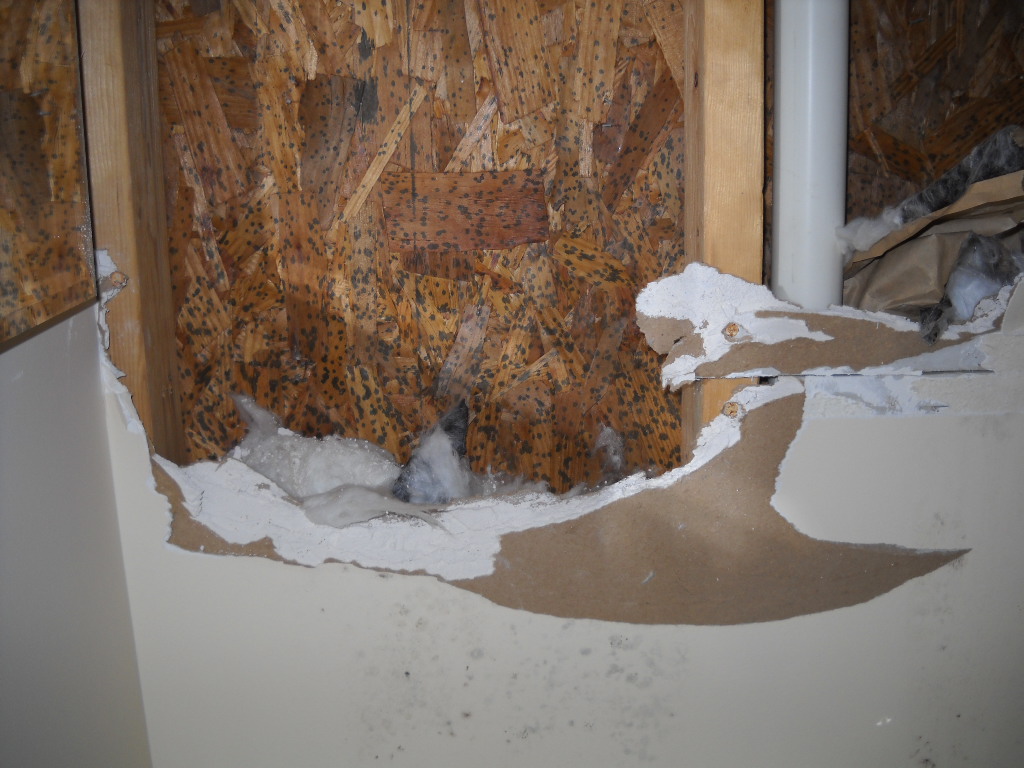
The last two pictures show where water has affected the flooring and the framing in the home. It appears that this was not detectable without removing drywall. Again, it's really hard to detect.

My reason for posting this particular topic was to make sure that sellers, and especially buyers, were aware of these problems related to stucco. If you are a home buyer you need to know of things like this so you can better make an informed decision when purchasing a home. Because I work with only home buyers I try to stay up on issues like this for the sake of my clients. Information is power, especially when it come to buying a home. The more information, the better.


These pictures were provided by David Tamny, with Professional Property Inspection. If you have any questions or concerns please feel free to contact him. He has become somewhat of local "expert" on stucco and mold issues. FYI, there is no specific test or inspection for this sort of thing. Typically, an inspection can include a visual inspection, pictures with an infared camera such as this, mold testing by scraping and air-quality sampling, and more invasive procedures like removing drywyall, framing or wall board.


Monday, November 29, 2010

What Do Buyers Look For in a Real Estate Agent?

So, the National Association of Realtors puts out a "Profile of Home Buyers and Sellers" every year for it's members. I downloaded and printed it, all 122 pages, (and in color as well, I might add). Being a bit of statistics guy I always look forward to data on buyers, sellers, the housing market, etc. That being said, I've been reading over some of the statistics for the past year, 2010.

Since I work only with buyers I'm mostly interested in what buyers have to say about their experiences in this past year with buying a home. This profile is exhaustive. Unfortunately, if you are not a Realtor, you cannot read it on-line or download it. However, I think you can purchase a copy from the website.

Anyway, regarding what buyers wanted regarding their agents a couple of things stood out:

1. When buyers were ask what they most wanted mostly from their agents, 51% of buyers said the most important thing they wanted from their agent was to help them find the right home. The second most important thing they want from their agent, at 14%, was to help them negotiate the terms of the sale. Help with price negotiations came in at 12%.

2. When buyers were asked "what is the most important factor when choosing an agent" 32%, the highest percentage, said that the agent is honest and trustworthy. The next closest answer, at 20%, was the reputation of the agent.

The data also shows that 83% of all people people who purchased a home in 2010 used a real estate agent/broker, which is up 6% over 2009 and up 15% over 2001. I find this interesting since 89% of all buyers use the internet in one form or another to help them in their home purchase. So, although buyers are searching for homes on the internet on their own, more of them are turning to a Realtor to help them complete the transaction. This is good news for us Realtors and it also show that the internet, with all of the listings available to anybody, is not our enemy, it's really our friend.

Going back to points (1) and (2), I just want to make a couple of observations. First, buyers want somebody to help them find the right home, the home that is for them. They don't want a slick-talking agent who chauffers them around and shows them homes that the agent likes. They want somebody to listen to their needs and wants and they want an agent who interacts with them on a personal level. The want somebody who is responsive. Gone are the days when an agent's job was just to drive you around a couple of times and "sell you a home." Buyers these days are seekers, seekers of information and seekers of agents who will actually help them to find a home and listen to what they want. Buyers want to be treated like they are valuable and like they matter. They don't just want to be a number, one of several "customers" for the average agent. They want to be treated as "clients," as somebody who has real value to their agent.

And then, even in 2010, the most important factor in choosing an agent is finding one who is honest and trustworthy. Not one who knows everything about everything in real estate, not one who's flashy, not one who has a bunch of designations next to their name. Buyers want somebody they can trust. Is that surprising? Well, if they are looking for somebody who they can actually establish a relationship with and who will be responsive to their wants and needs, doesn't it follow that they would have to trust that person as well? Of course it does. They are putting their trust in somebody because they need somebody who will guide them down the path to home ownership. And they are not willing to start down that path with somebody they don't trust. Again, not like the old days when you just "bought a house from the local Realtor." Buyers are much more sophisticated these days and they want the same rights that sellers have always had. They want an agent who is working for them, not just with them.

Monday, November 22, 2010

Buying a Home? Use an Exclusive Buyer's Agent

I was eventually going to break down different types of "agency" and "representation" offered to people who choose to buy a home. However, I feel this video does a better job of explaining "representation" for home buyers than anything I could have put in writing. This video is from NAEBA, the National Association of Exclusive Buyer Agents, a group that I have been a member of since 1997. They are an ADVOCATE for home buyer's rights. Watch the entire video, it really breaks down how having your "own" agent will protect you and why its not just a good idea, It's necessary.


http://www.facebook.com/index.php#!/video/video.php?v=1599654625844&oid=45574398770&comments

Tuesday, November 16, 2010

Another One Bites the Dust


I've been in real estate for some time now yet it never ceases to amaze me what kind of shenanigans go on in some circles within the industry. Yeah, we've all heard the jokes about Realtors, some that are true, but most Realtors are upstanding individuals, possibly even former Boy Scouts or Brownies.

And then there are the others. The scammers. The shady ones. The opportunists gone wild. Yep, our industry has them. Of course, out of 1,000,000 Realtors nationwide you know that there have to be a few bad apples.

So every few years a handful of people get arrested locally in some type of real estate scheme. I've know OF many of the Realtors that have been arrested and/or convicted but I don't know any of them personally. I haven't transacted business with any of them and I don't have any ties to their co-conspirators. Maybe I stay away from things that just don't feel right, or maybe I'm just lucky.

Greed is usually the driving force behind most of the antics. Of course, greed can be traced to a lot of questionable activity.

There are three things that amaze me about these kinds of stories:

1. The people involved are not petty criminals and the schemes are elaborate and well-thought.
2. The greed is over-the-top. They steal and cheat in order to feed their lives of luxury.
3. They seem to think that they will never get caught but almost almost always do.

There have been several of these "rings" that have been broken up over the years. I had a friend that actually worked for one of the ring-leaders in one of them for a short time. I'm pretty sure that my friend had no idea. Or at least they haven't caught up with him yet. (I haven't seen him in years, he moved out of state)

The reason I wanted to post this is because a recent follow-up to a story about one of these incidents. One of the Realtors involved was recently sentenced to jail. Here is the initial story and the follow-up:

U.S. Justice Department

http://www2.nbc4i.com/news/2010/nov/10/columbus-real-estate-agent-sentenced-mortgage-tax--ar-286656/


This lovely little scam involved two Realtors, a builder, the builder's wife, an accountant, and who knows who else. They were charged with money laundering, tax fraud, wire fraud, and obstruction of justice. Did they get caught? Yes. But in the meantime they defrauded people out of millions of dollars. As a Realtor I am not "happy" that my fellow Realtors are going to prison. I try not to take pleasure in the displeasure of others. However, I am glad that justice was served and people are going to pay. I hope that is a lesson to those "questionable" people in this industry who may be teetering on the edge of bad judgment. Just remember: you likely will get caught.